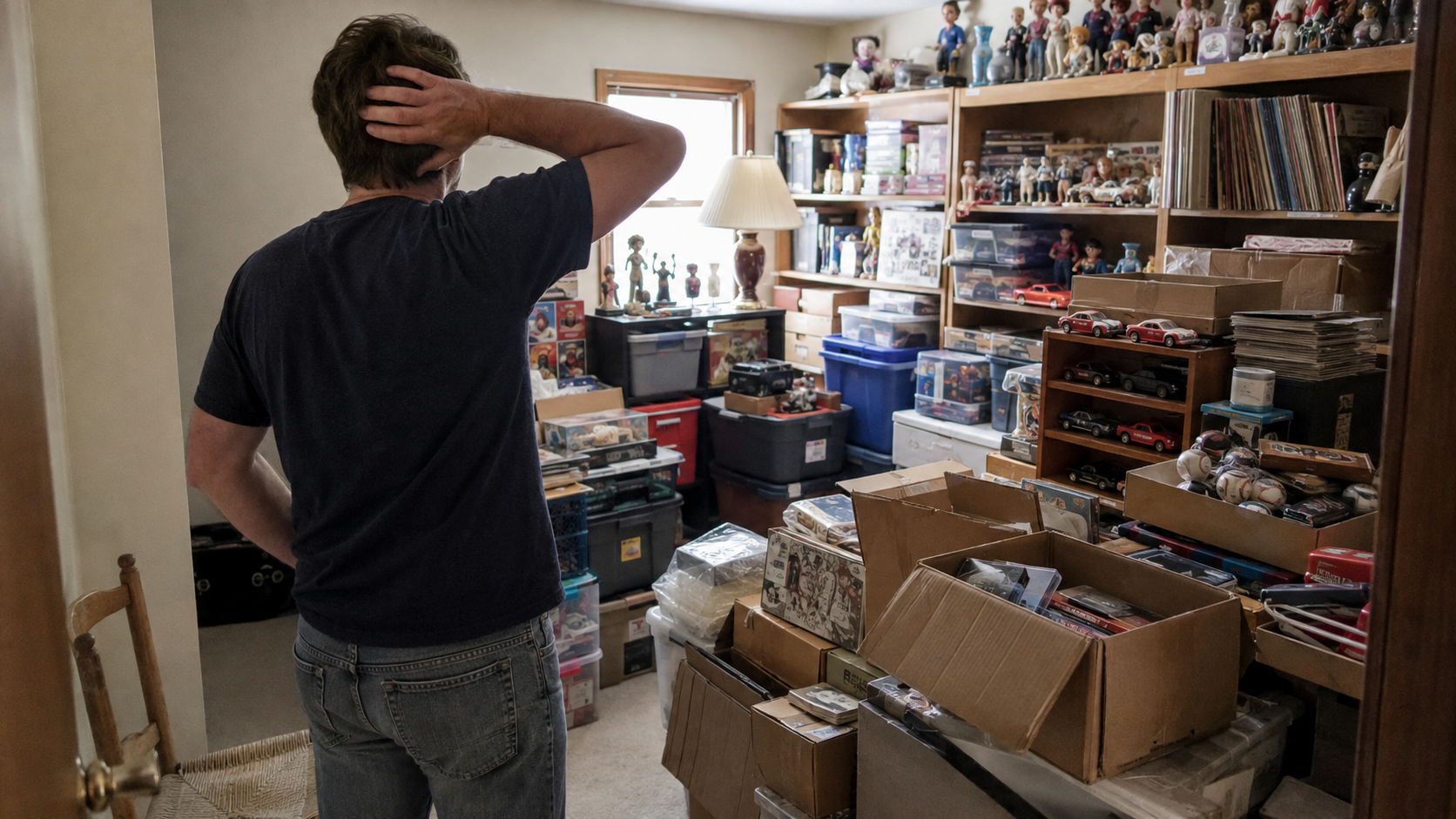
A lot of millennials are reaching the age where they are inheriting collections from their parents. It could be toys, records, sports memorabilia, antiques or just a house full of things collected over 30 or 40 years.
I deal with this all the time through my resale business. I buy large collections from people who inherited them but have no idea what they are worth or how to move them.
The first thing you need to figure out is simple: Do you want the most money possible, or do you want the collection gone?
A $20,000 Collection Is Not $20,000 in Your Pocket
Someone may tell you the collection is worth $20,000. That does not mean another buyer will hand you $20,000 for everything.
That number usually represents what every item could eventually sell for separately. To get close to it, you would need to research, photograph, list, store, pack and ship everything yourself.
You also have to subtract selling fees, shipping supplies, returns and possibly taxes. Then there is the value of your time. A large collection can take months or even years to completely sell.
Unless you already sell regularly on eBay or another platform, you may be taking on a second job without realizing it.
Don’t Look Up Every Single Item
You do not need to research hundreds of items individually just to understand what you have.
Start by figuring out the general category of the collection. Search similar items on eBay, select Sold Items and sort the results from highest price to lowest.
This is important because active listings only show what sellers are asking. Sold listings show what buyers have actually paid.
Look through the highest-priced results and see if you recognize anything from your collection. Focus on the unusual, older or harder-to-find pieces. Once you identify the best items, you should have a decent idea of whether the collection contains anything especially valuable.
You are not trying to calculate the value down to the last dollar. You are trying to make sure you do not accidentally include a $1,000 item in what you thought was a box of $10 items.
Selling Everything Together
For most people, selling the entire collection to one buyer at a discount is the easiest option.
You will not receive the full potential retail value because the buyer still has to do all the work. They need room to cover selling fees, shipping, items that never sell and the time it may take to get their money back.
That discount is not necessarily money you lost. You are paying someone else to take on the work and risk.
You can list the collection on Facebook Marketplace or Craigslist. Include clear photos, a basic description and any valuable pieces you identified. You can also search both platforms for people advertising that they buy collections.
Get more than one offer if possible, but be realistic about the difference between retail value and a bulk cash offer.
Decide What Your Time and Space Are Worth
If you enjoy researching and selling, you may be able to make more by separating the collection. Start with the most valuable items and sell the cheaper pieces together in lots.
If you have no interest in becoming an online seller, it may make more sense to accept a fair bulk offer, clear the space and move on.
Space also has a real cost, especially today. As I explained in my article about the cost of living over time, housing is one of the biggest reasons life feels less affordable now. Filling a garage, spare room or storage unit with an inherited collection for years is not free.
An inherited collection can be valuable, but turning that value into actual money comes with costs. The best choice is not always the one that produces the highest total sales. Sometimes getting a reasonable amount of cash now—without spending the next year surrounded by boxes—is the better financial decision.
Leave a Reply